Saturday, September 16, 2023

8-bit, 2D Tournament Fighting!

Want to play a fighting game?

Sure, let's play Tekken!

Nah, too many dimensions. How about something 2D?

Sure, let's play Street Fighter 6!

Nah, too many graphics. How about something older?

Super Turbo?

Nah, I want ninjas in my game.

Mortal Kombat?

Nah, too serious. How about Teenage Mutant Ninja Turtles Tournament Fighters?

Sure, we can play Tournament Fighters on SNES! That's a cult classic!

Sure it's good, but what if we played a version with fewer buttons, fewer characters, and a totally different story?

You mean?

That's right, Teenage Mutant Ninja Turtles Tournament Fighters for the NES! This is a game that completely passed me up during my childhood. I loved playing TMNT II: The Arcade Game on NES and Turtles in Time on the SNES, but I completely ignored Tournament Fighters in all of its forms. I had a vague recollection that each version was different, but since I only ever had screenshots to go on. It's not that I wouldn't have played it if it weren't in front of me. You just have to know the context of the time. Games were expensive, not always available in your local area, or just passed over in favor of other games that you did come across.

As I have gotten older, I have developed a fascination of different versions of the same game. You may not think about it much anymore now that games that go multiplatform are the same game. Minor differences in technical performance or perks for buying it on one console or another aside, getting the same game on more than one contemporary platform for the most part comes down to your preference for where or how you want to play it. You might be more familiar with this concept with the debate of which version of Aladdin is better - SNES or Genesis? Those were two different games with the same title! I even love seeing the differences between two versions of a game that are almost the same. For example, we've got two versions of Street Fighter II Turbo or Street Fighter II: Special Champion Edition for the SNES and Genesis. They are practically the same game, but I love the minor differences in how the same games are interpreted through the hardware. This doesn't come down to one being as technical as "one has a different framerate" but more like a watercolor versus paint approach. On an artistic level, I find it fun to compare two different interpretations of the same work (in the case of Street Fighter II, the arcade games they are based on).
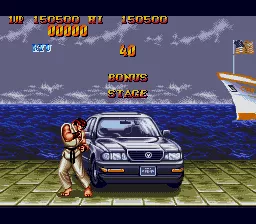
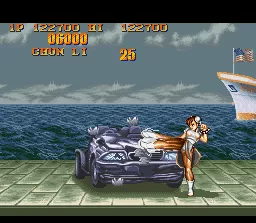

Images from MobyGames. Street Fighter is a trademark of Capcom.

Back to TMNT, Tournament Fighters falls more into the Aladdin discussion. The Cowabunga Collection has all three versions - SNES, Genesis, and NES. This is not going to be an in-depth review of the NES version. I just wanted to share some observations that I had while playing this game.

  • I love the fact that despite the source material, there are no weapons. Pick your favorite turtle in story mode, and you're going hand-to-hand. In the story, Shredder has had enough of the status quo and just wants to fight in the streets!


I notice Shredder doesn't say "no weapons" in his note!

  • It's been said elsewhere, but I'd like to reiterate that it's fascinating this game exists. It's in the rare company of being a 2D one-on-one, Street Fighter style fighting game on the NES. That was very rare when you don't include the unofficial, unlicensed, and bootleg NES fighting games that are out there.
  • Being a fighting game on the NES, it is shocking how well this game controls. I don't associate Konami with fighting games, but their technical skill with hardware in the 90's still stands up. The overall game runs surprisingly well.
  • There are some special moves, too! When I played as Raph, he had a E. Honda headbutt move!


Or is this a Psycho Crusher?
  • As each round progresses, occasionally a power up will fly onto the screen and drop a ball. Pick up the ball, and if you do a Hadouken motion (do I even need to tell you this command?), you'll throw it forward like a projectile. I didn't have anyone to play with in multiplayer, but I imagine it makes some fights interesting!
  • Like most 2D fighters I've played, it even has grabs!

The dreaded tick-throw from Street Fighter II strikes back!
  • When I first played this game, I beat it on Normal. I didn't finish it this most recent time (you have limited continues!), but I'll share my original screenshot of the reward for your hard work. As a side note, this game is incredibly challenging on Hard and you only get one credit!

Typical 90's ending when you had multiple difficulty options.

There's certainly more to say about this game, but I wanted to share my brief thoughts about this game. I have to imagine this game was written off compared to the other versions of this game. I would like to encourage you to step outside of your comfort zone and try a game that you might have passed over before. You may be surprised how much fun you have with it!

Note: Unless otherwise noted, screenshots were captured by me. Teenage Mutant Ninja Turtles is owned by Nickelodeon. The Cowabunga Collection was developed by Digital Eclipse and published by Konami. The original Teenage Mutant Ninja Turtles Tournament Fighters was developed and published by Konami.

Saturday, August 26, 2023

On Replaying Games

Have you ever heard of the "Backlog of Shame"? I find it's most commonly associated with people's massive Steam (digital game shop) libraries, but it can really apply to any sort of entertainment options that people say they will get around to but may or may not. I guess it's most associated with Steam because it is so easy to pick up cheap games. The logic behind it is that when I was a kid (old man alert!), games were very expensive, so you didn't typically just get a new game every week or month (or days, anyone?). You had to make the most of what you had. In my case, I remember getting a game on my birthday, during the holidays, and on some other special occasions if I was lucky (or had generous relatives!). Other than that, renting was where it was at. Before I go full Grampa Simpson and rant about the onion strapped to my belt (which was the style at the time!), I should get to the point.

image of Grampa Simpson telling a story: "So I tied an onion to my belt, which was the style at the time."

Image generated using Frinkiac. The Simpsons is owned by Disney.

Once we got access to larger libraries of cheaper games, a lot of us have libraries of games that span hundreds of games. If you sat down and tried to play through every single game the way we did when I was a kid, I am certain you would devote decades of your life. In fact, the HowLongToBeat website could likely be used to get a ballpark amount of time, but some things are better left unknown. As a result, we have to make a choice with our time. I'll read online about how people make these elaborate plans to get through their Backlog of Shame, much in the way you might try to tear through your backlog at work. I've tried sometimes to intentionally play games I already own rather than buying something new that catches my eye (I know, what a concept!), but I find when I do, I start to feel a weird pressure. That backlog really does turn into work. At some point, I had to give up and tell myself that I will never play through all of my games in the backlog. This is an extremely first-world problem, but it's a question of how we spend our leisure time, which I think is still an important one for our personal satisfaction. You could apply this to book, movies, or any other thing we do with our spare time. 

"Seriously, what's the point?" you might ask, tapping your foot like Sonic. Well, don't jump off the level just yet, because I'm getting there.


The concept of playing through a game backlog, or ignoring it and playing new things, is how to address replaying a game! This Reddit link (Do you replay games? r/patiengamers) is just one of many examples where someone actually feels guilty about replaying a game in the face of having a backlog of other games to play. As you can see in this link and others similar to it, there are a wide range of opinions, but just the fact that people feel guilty of not playing something new is an interesting thought experiment. One user comments along the lines that it reflects our consumerist culture, that we always have to be purchasing something new. I think it's a bit more complex, although I get that view.

I fit in the "and/both" category. I have a large library of games, but I also love replaying games. Growing up on and still enjoying classic games has conditioned me to replay them frequently. I can't imagine just playing through Megaman X once and then telling myself, "Well that was fun, but once is enough. I have other games to play!" Sure, I might move on to another game to play for awhile, but eventually, I'll get that itch. It's a weird sort of feeling that makes me want to revisit something. Even though playing through it will be familiar, I don't think of it as just doing the same thing over and over again. In a game like Megaman X, you can play it in a different order, give yourself restrictions (such as limiting what upgrades you get), or trying to speedrun it. 

Sketch of boss select screen from Megaman X. Three different colored paths are drawn through each boss square to represent three different ways to play through the first part of the game.

Sketch I made of the boss select screen in Megaman X. I've just given you three different ways to play!

Even then, if you decided to replay the game in the same way you did previously, I don't think of that as wasting time. That is more like you enjoyed the vacation, tour, movie, etc., so much that you want to get as much out of it as you can! Each time you experience something, that experience is a two-way street. Sure, Capcom didn't change the data in the Megaman X cartridge between my playthroughs, but I certainly change a bit each time I experience something because I am not a static entity. In both my second and third playthrough of the game, I may have played the game before and understand how to beat certain bosses, but they are still different because each time I play, the snapshot of how I perceived the game on my end changes in some way. Maybe I get better at dodging certain attacks, or I prefer to take certain hits like a tank so I can bypass a set of spikes. Even speedrunners who learn how to optimize their playthroughs may spot ways to further innovate their runs along the same general path!

This is just the beginning of this line of thought, because I haven't even touched on randomizers, procedural generation, or a mix of the two, but I hope that if you have never gone back to replay a game you've played or finished before that this encourages you to do so. Never give up your interest in trying new things, but don't forget that you can still have a great time retreading an older path!